
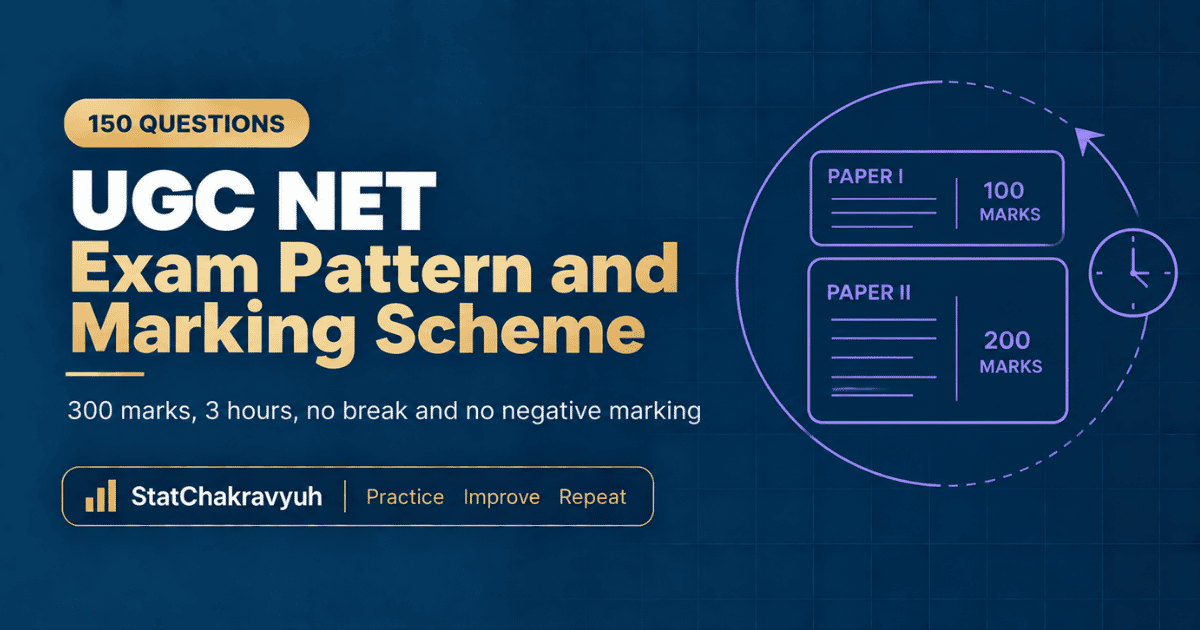
Quick answer. UGC NET is a three hour Computer Based Test with 150 multiple choice questions carrying 300 marks. Paper 1 has 50 questions worth 100 marks and is common to every subject. Paper 2 has 100 questions worth 200 marks and is subject specific. Every question carries 2 marks and there is no negative marking anywhere in the paper. There is no break between the two papers and all questions are compulsory.
Question Paper Structure
| Paper | Questions | Marks | Content |
|---|---|---|---|
| Paper 1 | 50 | 100 | Teaching and research aptitude, reasoning, comprehension, general awareness. Common to all subjects. |
| Paper 2 | 100 | 200 | The subject you selected. Assesses domain knowledge. |
| Total | 150 | 300 | 3 hours, 180 minutes, no break |
Both papers consist entirely of objective type multiple choice questions. All questions are compulsory.
There is no break between the papers. The three hours run continuously across both. Nobody tells you when to move from Paper 1 to Paper 2, and you may move between them freely. How you split those 180 minutes is entirely your decision, and it is one of the few strategic choices this examination gives you.
Marking Scheme
| Outcome | Marks |
|---|---|
| Correct answer | +2 |
| Incorrect answer | 0 |
| Unanswered or marked for review | 0 |
There is no negative marking for an incorrect response.
What Happens When a Question Is Flawed
NTA publishes its rule for defective questions, and it is worth knowing because it affects how you treat ambiguous questions.
| Situation | Result |
|---|---|
| More than one option is found correct | 2 marks awarded to everyone who marked any of the correct options |
| All options are found correct | 2 marks awarded to everyone who attempted the question |
| No option is correct, the question is wrong, or the question is dropped | Handled as specified by NTA in the final answer key |
Notice what the first two rules mean in practice. On a question that later turns out to be defective, attempting it can earn you marks and leaving it blank cannot. That is one more reason not to leave anything unanswered.
The Rule That Changes Everything
Attempt all 150 questions.
There is no penalty for a wrong answer. A blank scores zero and a guess scores either two or zero. The expected value of a guess is positive and the expected value of a blank is exactly zero.
This is the single most important strategic fact about UGC NET, and it is the opposite of the discipline that GATE and IIT JAM build. If you are coming from either of those examinations, you have spent months training yourself not to guess. Unlearn it deliberately for this paper.
A practical habit. Keep four minutes at the end purely to fill in every unanswered question, even at random. Four minutes of guessing on twenty blanks will, on average, earn you marks. Four minutes of leaving them blank earns you nothing, guaranteed.
Time Management
180 minutes for 150 questions is 72 seconds per question on average. That average is misleading because Paper 1 questions and Paper 2 questions demand very different amounts of time.
A workable split:
| Phase | Time | What You Do |
|---|---|---|
| Paper 1 | 50 to 55 minutes | 50 questions. Most are quick. Comprehension and data interpretation take longer. |
| Paper 2, first pass | 90 minutes | Answer everything you know directly. Mark the rest. |
| Paper 2, second pass | 25 minutes | Return to marked questions and work through what is solvable. |
| Final sweep | 5 to 10 minutes | Fill in every blank. No exceptions. |
Do not spend more than 60 minutes on Paper 1. It carries a third of the marks but tends to feel easier, which tempts candidates into over investing there. Paper 2 carries twice the marks and needs the time more.
Test both orders in your mocks. Some candidates do better starting with Paper 2 while fresh and finishing with Paper 1. Settle on one approach before exam day and do not experiment during the actual paper.
Examination Conditions
| Condition | Detail |
|---|---|
| Mode | Computer Based Test only |
| Medium | English and Hindi, except language papers |
| Keyboard | Disabled for the entire duration. All answers entered using the mouse. |
| Changing answers | Permitted at any time during the examination |
| On screen clock | Countdown timer showing remaining minutes, set at the server |
| Technical failure | The candidate is moved to another system and the lost time is adjusted at the server so the full duration is preserved |
The medium of the question paper must be chosen carefully while filling the application form. It cannot be changed later, and in case of any discrepancy between the English and Hindi versions, the English version is treated as final.
The Three Qualifying Outcomes
UGC NET does not produce a single pass or fail result. There are three separate outcomes.
| Qualified for | JRF | Assistant Professor | PhD Admission |
|---|---|---|---|
| Category 1: Award of JRF and appointment as Assistant Professor | Yes | Yes | Yes |
| Category 2: Appointment as Assistant Professor and admission to PhD | No | Yes | Yes |
| Category 3: Admission to PhD only | No | No | Yes |
Cut offs are set separately for each category and each subject, and they differ by reservation category. Category 1 has the highest cut off.
Why this matters for your preparation target. A candidate aiming at JRF is competing for a much smaller number of positions than one aiming at Assistant Professor eligibility. Set your target score against the category you actually need, not against a general idea of “clearing NET”. The age limit also applies only to JRF.
Coverage and Speed, Not Depth Alone
UGC NET does not reward deep work on a few topics. It rewards broad coverage attempted quickly across 150 questions in 180 minutes with no break. That is a pace built through timed practice.
Common Pattern Mistakes
- Leaving questions blank. There is no negative marking. A blank is a guaranteed zero and a guess is not.
- Over investing in Paper 1 because it feels easier. It carries half the marks of Paper 2.
- Treating the three hours as two separate papers. There is no break and no forced switch. Budget the time yourself.
- Skipping the final sweep. Reserve time to fill every blank before the clock runs out.
- Preparing for a general pass mark rather than the specific category, JRF or Assistant Professor, you are actually targeting.
- Choosing the question paper medium carelessly during the application. It cannot be changed later.
Frequently Asked Questions
What is the UGC NET exam pattern?
UGC NET is a three hour Computer Based Test with 150 multiple choice questions carrying 300 marks. Paper 1 has 50 questions worth 100 marks and Paper 2 has 100 questions worth 200 marks. There is no break between the papers.
Is there negative marking in UGC NET?
No. There is no negative marking for an incorrect response. Unanswered questions score zero.
How many marks does each UGC NET question carry?
Every question carries 2 marks.
Is there a break between Paper 1 and Paper 2?
No. The three hours run continuously across both papers, and candidates may move between them freely.
Is Paper 1 the same for all UGC NET subjects?
Yes. Paper 1 is the General Paper on Teaching and Research Aptitude and is identical for every UGC NET subject.
Can I change my answers during the UGC NET exam?
Yes. Answers may be changed or modified at any time during the entire duration of the examination.
Is the keyboard usable during the UGC NET exam?
No. The keyboard is disabled for the entire duration. All answers are entered using the mouse.
What happens if a UGC NET question is found to be wrong?
If more than one option is correct, two marks are awarded to everyone who marked any correct option. If all options are correct, two marks are awarded to everyone who attempted it. Cases where no option is correct or the question is dropped are handled as specified by NTA in the final answer key.
What are the three UGC NET qualifying categories?
Award of JRF with Assistant Professor eligibility, appointment as Assistant Professor with PhD admission, and admission to PhD only. Each has its own cut off.