
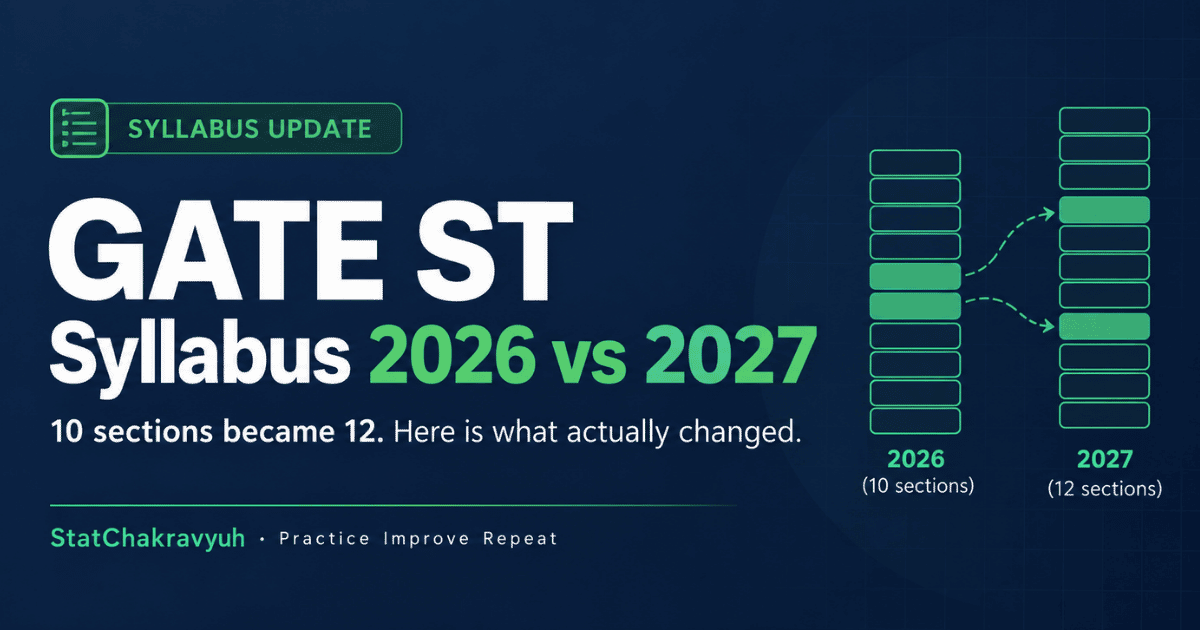
Quick answer. The GATE Statistics syllabus has been reorganised for 2027, not expanded. Ten of the twelve subject areas are unchanged. Two areas, Joint Distributions and Convergence of Random Variables, have been separated out of the distributions block and given their own section headings. No clearly new core subject area has been added to the ST paper. If you started preparing with the 2026 syllabus, you do not need to start again. You need to re index your notes, not rewrite them.
When IIT Madras announced that the GATE 2027 syllabi had been revised, a lot of Statistics aspirants panicked. The word “revised” in a notification usually means new topics, dropped topics and wasted months.
That is not what happened here. We compared the official GATE ST 2026 syllabus against the GATE ST 2027 syllabus line by line. This page tells you exactly what moved, what stayed, and what you should actually change.
The Short Version
10 subject areas remain essentially unchanged. 2 subject areas have been separated and given their own headings. 0 clearly new core subject areas have been identified.
If you have already covered probability and distributions properly under the 2026 syllabus, you have already covered joint distributions and convergence of random variables. They did not appear from nowhere. They were always there, buried inside a larger block, and are now visible as sections in their own right.
Complete GATE Statistics 2027 syllabus with all 12 sections
How the 2026 Syllabus Was Structured
The 2026 syllabus was presented as 10 broad sections:
- Calculus
- Matrix Theory
- Probability
- Standard Discrete and Continuous Univariate Distributions
- Stochastic Processes
- Estimation
- Testing of Hypotheses
- Non Parametric Statistics
- Multivariate Analysis
- Regression Analysis
The content on joint distributions, order statistics, sampling distributions, modes of convergence and the limit theorems sat inside and immediately after the univariate distributions section, without carrying separate headings of their own.
That created a practical problem. A student reading the 2026 syllabus could finish the distributions section, tick it off, and never notice that Slutsky’s lemma, the Borel Cantelli lemma or the joint distribution of order statistics were sitting in the same block.
How the 2027 Syllabus Is Structured
The 2027 syllabus breaks that block into clearly identifiable components, producing 12 sections:
- Calculus
- Matrix Theory
- Probability
- Standard Discrete and Continuous Univariate Distributions
- Joint Distributions
- Convergence of Random Variables
- Stochastic Processes
- Estimation
- Testing of Hypotheses
- Non Parametric Statistics
- Multivariate Analysis
- Regression Analysis
The difference in one line
2026: Probability, then Distributions, with joint distributions and convergence folded into the same continuous block.
2027: Probability, then Univariate Distributions, then Joint Distributions, then Convergence of Random Variables, each standing on its own.
Full Comparison Table
| Subject Area | GATE ST 2026 | GATE ST 2027 | Change |
|---|---|---|---|
| Calculus | Section 1 | Section 1 | Unchanged |
| Matrix Theory | Section 2 | Section 2 | Unchanged |
| Probability | Section 3 | Section 3 | Unchanged |
| Standard Univariate Distributions | Section 4 | Section 4 | Unchanged |
| Joint Distributions | Inside the distributions block | Section 5, separate | Reorganized |
| Convergence of Random Variables | Inside the distributions block | Section 6, separate | Reorganized |
| Stochastic Processes | Section 5 | Section 7 | Unchanged |
| Estimation | Section 6 | Section 8 | Unchanged |
| Testing of Hypotheses | Section 7 | Section 9 | Unchanged |
| Non Parametric Statistics | Section 8 | Section 10 | Unchanged |
| Multivariate Analysis | Section 9 | Section 11 | Unchanged |
| Regression Analysis | Section 10 | Section 12 | Unchanged |
Read the section numbers carefully. Stochastic Processes moved from section 5 to section 7, and Regression Analysis moved from section 10 to section 12. Those are numbering shifts caused by the two new headings inserted before them. They are not content changes. If you see a coaching notice claiming that six sections changed, this renumbering is what they are counting.
Why This Change Was Made
GATE does not explain its syllabus decisions publicly, so anything here is interpretation rather than official reasoning. That said, the change makes practical sense for two reasons.
First, it improves clarity. Joint distributions and convergence are conceptually different from univariate distributions. Grouping them under one heading suggested a closeness that does not exist. A student studying the Poisson distribution and a student studying the Borel Cantelli lemma are doing very different work.
Second, it matches how the subject is actually taught. Most postgraduate Statistics curricula treat joint distributions and convergence as separate units. The 2027 presentation matches standard textbook organisation, particularly Casella and Berger, where multiple random variables and properties of a random sample are separate chapters.
The reasonable conclusion is that this is a presentation improvement, not a signal that these two areas will be tested more heavily. Nobody can predict question distribution for GATE 2027, and any claim otherwise should be treated with caution.
What This Means for Your Preparation
GATE Statistics preparation guide
If you started preparing in 2026 or earlier
Your material is still valid. Do these three things and you are current.
1. Re index your notes. Split your distributions notebook into three parts: univariate distributions, joint distributions, and convergence. Same content, clearer separation.
2. Audit the convergence topics specifically. This is the area most likely to have been skimmed under the old structure. Check that you have actually covered all four modes of convergence, the implication relationships between them, Slutsky’s lemma, the Borel Cantelli lemma, both laws of large numbers and the Central Limit Theorem.
3. Audit joint distributions the same way. Order statistics, transformations of random vectors, joint moment generating function, the multinomial and bivariate normal distributions, and the chi square, t and F sampling distributions.
Registration closes on 27 September
If you are starting fresh for 2027
Use the 2027 structure from day one. Do not download an old syllabus PDF from a coaching website. Take it from the official GATE 2027 site.
Official GATE 2027 syllabus PDF download
The one genuine risk
The risk is not that you missed new content. The risk is that under the 2026 structure, convergence of random variables was easy to under prepare because it did not look like a full section.
It looks like a full section now. Treat it like one.
Five Things to Do This Week
- Download the official 2027 ST syllabus PDF and delete every older copy you have saved. Working from two versions is how mistakes happen.
- Rebuild your checklist with 12 sections, not 10. Sub topic level, one row each.
- Give Convergence of Random Variables a dedicated study slot. Two focused days is usually enough to cover it properly, and it pays for itself.
- Re solve the convergence and joint distribution questions from previous year papers. These questions were always being asked. Only the heading changed. previous year questions from all eight ST papers
- Ignore any source claiming the ST syllabus has major new topics. Compare against the official PDF before you believe it, and before you buy anything based on it.
Frequently Asked Questions
Has the GATE Statistics syllabus changed for 2027?
Yes, but the change is structural rather than substantive. The GATE 2027 Information Brochure confirms the syllabi were revised. For Statistics, the syllabus is now presented in 12 sections instead of 10, with Joint Distributions and Convergence of Random Variables listed as separate sections.
Are there any new topics in the GATE ST 2027 syllabus?
No clearly new core subject area has been identified. The topics under Joint Distributions and Convergence of Random Variables were already present in the 2026 syllabus within the distributions block.
Do I need to restart my GATE Statistics preparation?
No. Reorganise your notes to match the 12 section structure and audit your coverage of Joint Distributions and Convergence of Random Variables, which were easy to under prepare under the older presentation.
Which sections were removed from the GATE ST syllabus in 2027?
None. All ten areas from the 2026 syllabus appear in the 2027 syllabus. The section count rose from 10 to 12 because two areas were given separate headings.
Why did Stochastic Processes move from section 5 to section 7?
This is a numbering shift, not a content change. Two new section headings were inserted before it, pushing every following section forward by two.
Will Joint Distributions and Convergence carry more marks in GATE 2027?
GATE does not publish topic wise weightage for the Statistics paper, and no prediction about question distribution can be made reliably. The separation improves clarity in the syllabus document. It should not be read as a guarantee of higher weightage.
Where can I get the official GATE ST 2027 syllabus?
The official syllabus PDF is published on the GATE 2027 website maintained by IIT Madras. Always use the official document rather than a coaching copy, because older versions still circulate widely.