
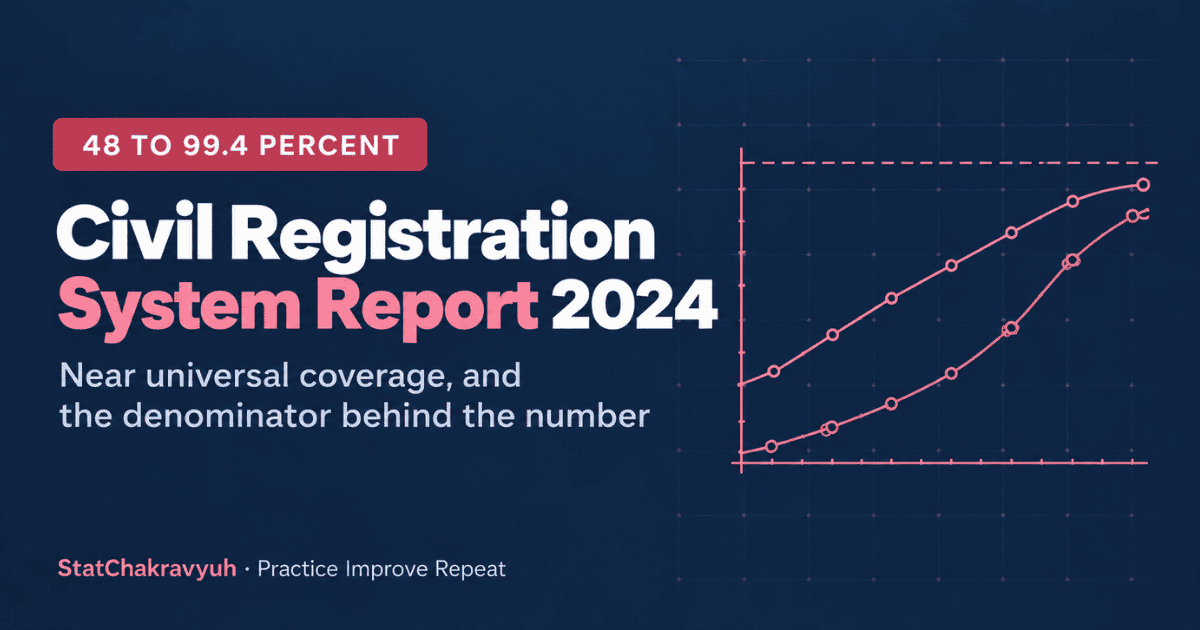
The Civil Registration System Report 2024 records something that sounds like a straightforward success story and is actually a lesson in how to read an official statistic.
India now registers almost every birth and almost every death. That is a genuine achievement. It is also a number measured against another number, and a statistics candidate should be able to say why that matters.
Short answer. India achieved near universal registration of vital events in 2024, with 99.1 percent of estimated births and 99.4 percent of estimated deaths officially registered, according to the Civil Registration System Report. In 2000 the corresponding figures were 56 percent and 48 percent. The system operates under the Registration of Births and Deaths Act, 1969, amended in 2023, and the report is published by the Registrar General of India.
What the Civil Registration System Is
It is India’s official mechanism for continuously recording births, deaths and stillbirths.
The word continuously is what distinguishes it from a census. A census is a snapshot taken at intervals. Civil registration is a running record of vital events as they occur.
| Particular | Detail |
|---|---|
| Legal basis | Registration of Births and Deaths Act, 1969, amended in 2023 |
| Publishing authority | Office of the Registrar General and Census Commissioner of India |
| Parent ministry | Ministry of Home Affairs |
| Operational since | 1970 |
| Registration mode | Digital, following the 2023 amendment |
| Prescribed reporting period | 21 days |
Two provisions worth carrying into an answer. Deaths of Indian citizens occurring abroad and registered at Indian consulates are recognised as valid under Indian law. Registrars who fail to perform their statutory duties may face a penalty of up to one thousand rupees.
What the Civil Registration System Report 2024 Shows
| Year | Birth registration | Death registration |
|---|---|---|
| 2000 | 56 percent | 48 percent |
| 2014 | About 86.6 percent | About 72.5 percent |
| 2024 | 99.1 percent | 99.4 percent |
Eighteen states and union territories achieved complete registration of births, and twenty one reported 100 percent death registration.
The death figure is the remarkable one
Read that table again and notice which line moved further.
Death registration is universally harder than birth registration. Births largely occur in institutions where reporting is built into the process. Deaths frequently occur at home, especially in rural areas, with no automatic reporting trigger.
Moving death registration from 48 percent to 99.4 percent in twenty four years is the genuine achievement in this report.
Saying so shows you understand the difference between the two series rather than treating them as one number. Most answers will quote both figures. Very few will explain why one of them was harder.
The Caveat That Belongs in Your Answer
This is where a statistics candidate separates from everyone else, and the report itself makes the point, so you are not inventing scepticism.
Registration completeness is assessed against estimates from the Sample Registration System, a large scale demographic survey that provides independent estimates of births and deaths.
The logic is simple:
Completeness = Registered events ÷ Estimated eventsThe difficulty is equally simple. If the Sample Registration System itself under reports births or deaths, the denominator is too small, and the completeness ratio comes out too high.
The report acknowledges that actual completeness could therefore differ from the reported figures.
Write that in one sentence and you have demonstrated something no amount of memorised data can show: that you understand a statistic is only as reliable as the benchmark it is measured against.
This is exactly the kind of reasoning an interview board is probing for when it asks a statistics candidate about official data.
Why This Connects to the Census
Civil registration and the census are the two halves of India’s demographic measurement.
| Census | Civil Registration System | |
|---|---|---|
| Frequency | Every ten years | Continuous |
| What it captures | A complete snapshot | Events as they occur |
| Strength | Total coverage at a point in time | Currency between censuses |
| Weakness | Ages immediately after collection | Depends on reporting behaviour |
Between two censuses, civil registration is the only continuous source of vital statistics India has. With Census 2027 arriving after a fifteen year gap, that role has mattered more in the last decade than in any comparable period.
How This Is Asked in the UPSC ISS Paper
General Studies, Question 3, covers demography and social development.
Statistics Paper II, Official Statistics, covers the Indian Statistical System, its registration mechanisms and its major data collections directly.
Statistics Paper IV, Demography and Vital Statistics, is one of the seven optional sections. If you have chosen it, this report is your subject.
Model answer skeleton, about 200 words
- Opening. The Civil Registration System Report 2024 records 99.1 percent birth and 99.4 percent death registration, against 56 and 48 percent in 2000.
- What the system is. Continuous recording of births, deaths and stillbirths under the 1969 Act as amended in 2023, published by the Registrar General.
- The progression. 2000 to 2014 to 2024, with the death series as the harder and more impressive climb.
- Why death registration is harder. Institutional births against home deaths with no automatic reporting trigger.
- The measurement caveat. Completeness is measured against Sample Registration System estimates, so under reporting in the denominator would inflate the ratio.
- Closing. Near universal coverage is a real achievement and a measured one. The number is only as good as the benchmark behind it.
Three Mistakes to Avoid
Treating the two percentages as one fact. They come from different underlying difficulties. An answer that explains why death registration lagged is worth more than one that quotes both figures.
Confusing civil registration with the census. One is continuous, the other decennial. They are complements, not versions of the same exercise.
Skipping the denominator problem. It is the only part of this topic that a statistics candidate can explain better than a general aspirant. Leaving it out wastes your entire advantage.
Frequently Asked Questions
What is the Civil Registration System in India?
India’s official mechanism for continuously recording births, deaths and stillbirths, operating since 1970 under the Registration of Births and Deaths Act, 1969, amended in 2023, and published by the Office of the Registrar General and Census Commissioner.
What does the Civil Registration System Report 2024 show?
That 99.1 percent of estimated births and 99.4 percent of estimated deaths were registered in 2024, against 56 percent and 48 percent respectively in 2000.
How is registration completeness measured?
By dividing registered events by the number of events estimated by the Sample Registration System, a large scale demographic survey providing independent estimates of births and deaths.
Why could the completeness figures be overstated?
Because if the Sample Registration System itself under reports births or deaths, the denominator is too small and the resulting completeness ratio is too high. The report itself acknowledges this.
What is the prescribed reporting period for registration?
Twenty one days from the event.
Why is death registration harder than birth registration?
Births largely occur in institutions where reporting is built into the process, while deaths frequently occur at home, particularly in rural areas, with no automatic trigger for reporting.
How does civil registration differ from the census?
The census is a complete snapshot taken every ten years. Civil registration is a continuous record of vital events as they occur, and between two censuses it is the only continuous source of vital statistics available.
What Comes Next
Registration records births and deaths. The next article covers the survey that measures the health of everyone in between, and the controversy over what it stopped publishing.
Next: NFHS 6 findings, explained for UPSC ISS
Practice. Improve. Repeat.
Sources
Office of the Registrar General and Census Commissioner (censusindia.gov.in), Ministry of Home Affairs, Press Information Bureau (pib.gov.in).