
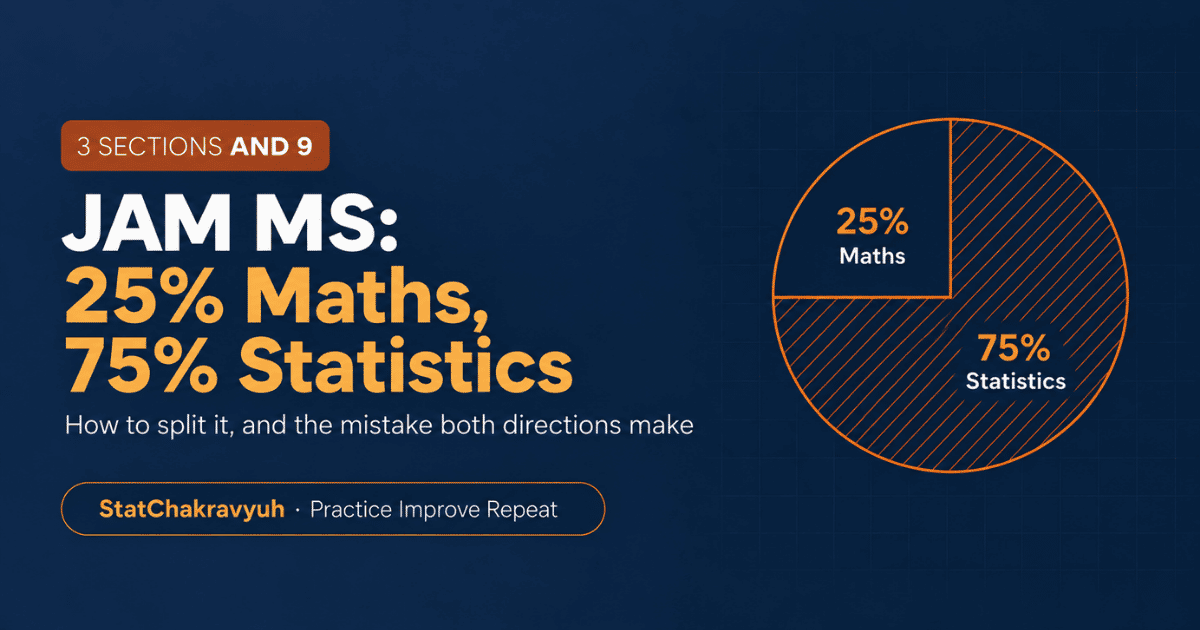
Quick answer. The official JAM MS syllabus divides into Sections 1 to 3, Mathematics, described as about 25 percent, and Sections 4 to 12, Statistics, about 75 percent. That is a syllabus level description, not a guarantee of question counts. The practical reading is that Statistics is your major focus and Mathematics is an essential supporting component. Both directions of error are common: candidates who skip the Mathematics lose a quarter of the syllabus, and candidates who over invest in it because it feels familiar lose more.
What the Official Split Actually Says
| Sections | Content | Stated weight |
|---|---|---|
| 1 to 3 | Sequences and Series of Real Numbers; Differential and Integral Calculus; Matrices and Determinants | About 25 percent |
| 4 to 12 | Descriptive Statistics and Probability, Univariate Distributions, Multivariate Distributions, Limit Theorems, Sampling Distributions, Estimation, Testing of Hypotheses, Nonparametric Methods, Stochastic Processes | About 75 percent |
Three Mathematics sections. Nine Statistics sections.
Read the word “about” carefully
The syllabus says about 25 percent. It is a description of how the syllabus is balanced, not a promise about any particular paper.
Do not build a timetable that assumes exactly fifteen of sixty questions will be mathematical. Build one that reflects the proportion of the syllabus, and leave room for the actual paper to differ.
The Two Mistakes, and Both Are Common
Mistake one: treating MS as a Statistics paper
The name says Mathematical Statistics and the cadre is statistical, so candidates jump straight to Section 4 and start with probability.
That skips a quarter of the syllabus, and worse, it skips the quarter that everything else is built on.
Mistake two: over investing in the Mathematics because it feels safe
This one is less obvious and it costs more.
A Statistics undergraduate has usually done more calculus and matrix algebra than they have done inference. So Sections 1 to 3 feel comfortable, and comfortable material is what people revise when they are avoiding hard material.
Two months of comfortable revision on 25 percent of the syllabus is how candidates arrive in February strong on sequences and weak on estimation.
Why the Mathematics Sections Matter More Than 25 Percent Suggests
This is the part that reframes the whole split.
The Mathematics sections are not a separate quarter of the paper. They are the machinery the other nine sections run on.
| Mathematics section | Where it reappears in the Statistics sections |
|---|---|
| Sequences and Series | Limit Theorems (7), convergence arguments throughout |
| Differential Calculus | Maximum likelihood estimation (9), maxima and minima of likelihood functions |
| Integral Calculus, improper integrals | Every continuous distribution’s expectation and variance (5), marginalising joint densities (6) |
| Beta and Gamma integrals | Gamma, Beta, chi square, t and F distributions (5, 8) |
| Double integrals, change of order | Joint and marginal distributions (6), transformations |
| Jacobian method | Distribution of functions of random vectors (6) |
| Matrices and Determinants | Quadratic forms, and the linear algebra behind multivariate results |
A weak grasp of improper integrals does not cost you marks in Section 2. It costs you marks in Sections 5, 6 and 8, where the question looks statistical but the failure is an integral you could not evaluate.
That is the real argument for the Mathematics sections, and it is stronger than the 25 percent figure.
A Split That Reflects Both Facts
Not 25 and 75 of your calendar. Something better shaped.
| Phase | Focus | Roughly |
|---|---|---|
| Phase 1 | Sections 1 to 3, Mathematics, properly and once | 20 to 25 percent of your total time |
| Phase 2 | Sections 4, 5, 6, the probability core | 25 percent |
| Phase 3 | Sections 7, 8, limit theorems and sampling distributions | 15 percent |
| Phase 4 | Sections 9, 10, estimation and testing | 20 percent |
| Phase 5 | Sections 11, 12, nonparametric and stochastic processes | 10 percent |
| Throughout | Previous year questions and timed practice | The rest |
The rule inside that table
Front load the Mathematics, then leave it.
Do Sections 1 to 3 first, do them properly, and then stop returning to them except for short revision. They are the foundation, and a foundation is built once.
Every hour spent re revising sequences in December is an hour not spent on estimation, which is where the marks are.
The Order Is Not Optional
The nine Statistics sections depend on each other, and on the three Mathematics ones.
Sections 1 to 3  ─────►  Sections 4, 5, 6  ─────►  Sections 7, 8  ─────►  Sections 9, 10
Mathematics              Probability core          Limits and sampling      Inference
                                    │
                                    └──────────►  Sections 11, 12
                                                  Nonparametric, Stochastic
Do not start Estimation before Sampling Distributions is solid. Do not start Sampling Distributions before Univariate and Multivariate Distributions are solid.
Candidates who ignore this order end up studying the same section twice, and the second time is not faster.
What “Properly and Once” Means for the Maths
Section by section, what the syllabus actually asks. This is narrower than a full mathematics course, and knowing the boundary saves weeks.
Section 1: Sequences and Series of Real Numbers
Convergence and limits, Cauchy sequences, bounded and monotonic sequences, Bolzano Weierstrass, limit superior and limit inferior. Series convergence, comparison, limit comparison, D’Alembert’s ratio, Cauchy’s nth root, Cauchy’s condensation and integral tests. Absolute convergence, Leibnitz’s test, conditional convergence, power series and radius of convergence.
Note limit superior and limit inferior, and Cauchy’s condensation test. Both are named and both are frequently skipped.
Section 2: Differential and Integral Calculus
One variable: limits, continuity, differentiability, Rolle’s, Lagrange’s mean value theorem, higher order derivatives, Leibnitz’s rule, Taylor’s theorem with Lagrange and Cauchy remainders, L’Hospital’s rule, maxima and minima with points of inflection.
Two variables: limits, continuity, partial and total differentiation, maxima and minima, Hessian matrix, saddle points, Lagrange multipliers.
Integral: fundamental theorems, Leibnitz’s rule, differentiation under the integral sign, improper integrals, Beta and Gamma integrals and the relationship between them, double integrals, change of order of integration, transformation of variables.
The Beta and Gamma integrals are the single highest return topic in this section, because they underpin the Gamma, Beta, chi square, t and F distributions you will meet in Sections 5 and 8.
Section 3: Matrices and Determinants
Vector spaces over the real and complex fields, span, linear dependence and independence, dimension, basis, null space. Matrix algebra, symmetric and skew symmetric, Hermitian and skew Hermitian, orthogonal and unitary, idempotent and nilpotent matrices. Determinants and their properties, rank and nullity, row reduction and echelon forms, systems of linear equations, Cramer’s rule, characteristic roots and vectors, Cayley Hamilton, quadratic forms and definiteness.
Note that Singular Value Decomposition is not here. It is in the GATE ST syllabus and not in JAM MS. If you are preparing both, keep the boundaries separate.
Checking Your Own Split
A simple test you can run this week.
Open your notes and count the pages. How many are Sections 1 to 3, and how many are Sections 4 to 12?
If the Mathematics is more than about a third of your notes, you are over invested in the comfortable material.
If Sections 9 and 10, estimation and testing, are thinner than Sections 1 and 2, you have your priorities inverted, because those two sections are the conceptual heart of the paper.
Frequently Asked Questions
What is the Mathematics weightage in JAM MS?
The official syllabus describes Sections 1 to 3, the Mathematics sections, as about 25 percent, and Sections 4 to 12, the Statistics sections, as about 75 percent. It is a syllabus level indication rather than a guarantee of question counts.
Can I skip the Mathematics sections in JAM MS?
No. They are a quarter of the syllabus, and more importantly they are the machinery the Statistics sections run on. Improper integrals, Beta and Gamma integrals, the Jacobian method and quadratic forms all reappear inside the Statistics sections.
Which Mathematics topic gives the best return in JAM MS?
The Beta and Gamma integrals and the relationship between them, because they underpin the Gamma, Beta, chi square, t and F distributions in Sections 5 and 8.
How should I split my JAM MS preparation time?
Around 20 to 25 percent on the Mathematics sections, done first and done once, then the remainder across the nine Statistics sections in dependency order, with the largest shares going to the probability core and to estimation and testing.
Is Singular Value Decomposition in JAM MS?
No. SVD is in the GATE ST Matrix Theory syllabus and is not part of the JAM MS syllabus.
What order should I study the JAM MS sections in?
Mathematics first, then the probability core of Sections 4 to 6, then limit theorems and sampling distributions, then estimation and testing. Nonparametric methods and stochastic processes can follow. Do not start estimation before sampling distributions is solid.
How do I know if my split is wrong?
Count your notes. If more than about a third are on the Mathematics sections, or if estimation and testing are thinner than sequences and calculus, the balance is inverted.