
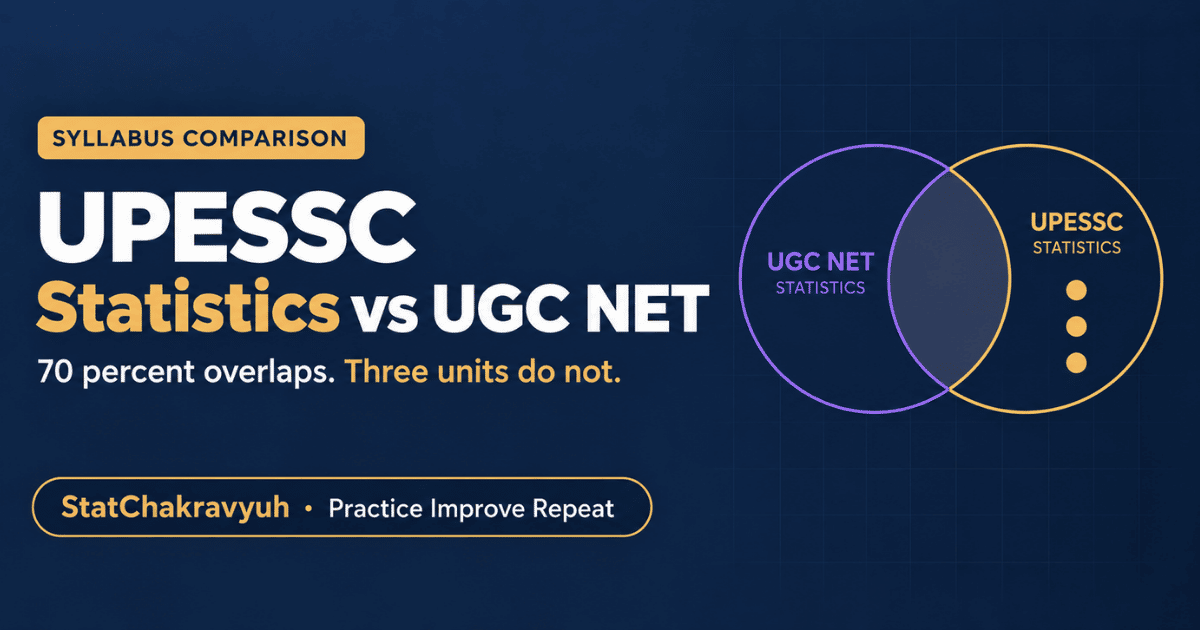
Quick answer. Every UPESSC Assistant Professor candidate already holds NET, SLET, SET or a PhD, so this is not a new syllabus from scratch. Roughly seventy percent of the UPESSC Statistics syllabus overlaps with UGC NET Statistics. Three units do not: Advance Probability Theory with measure theory, Statistical Quality Control, and Demography with Index Numbers. UPESSC also runs shorter, faster and with negative marking, which reverses the attempt strategy NET trained you into.
If you cleared NET, you are perhaps six weeks of focused work away from being ready. This page tells you which six weeks.
Why This Comparison Exists
UPESSC eligibility requires a Master’s degree plus NET, SLET, SET or a qualifying PhD. There is no route without one of them.
That means something unusual: every single person in the room has already passed a national level Statistics examination. Your competition is not general. It is a field of NET qualified candidates competing for 13 posts.
So the question is not “how do I prepare for UPESSC”. It is “what does UPESSC ask that NET did not”.
The Structural Differences
| UGC NET Statistics | UPESSC Statistics | |
|---|---|---|
| Purpose | Eligibility for Assistant Professor and JRF | Selection to a specific post |
| Subject code | 107 | 77 |
| Questions | 150, across two papers | 120 |
| Duration | 180 minutes | 120 minutes |
| Per question | 72 seconds | 60 seconds |
| Subject questions | 100 | 90 |
| Other questions | 50, Paper 1 aptitude | 30, General Knowledge |
| Marks per question | 2 | 3 |
| Negative marking | None | Minus 1 |
| Total | 300 marks | 360 marks written, plus 40 interview |
| Interview | No | Yes, 40 marks |
| Syllabus units | 10 | 10 |
Two of these matter far more than the rest.
Difference One: The Negative Marking Trap
UGC NET has no negative marking anywhere. If you prepared for it properly, you were told repeatedly to attempt all 150 questions, because a blank is a guaranteed zero and a guess is not.
That advice is correct for NET. It is expensive here.
| UGC NET | UPESSC | |
|---|---|---|
| Correct | +2 | +3 |
| Wrong | 0 | −1 |
| Blank | 0 | 0 |
Three wrong answers cancel one correct answer.
Work through what that means on a real paper. Suppose you know 70 questions confidently and are guessing on the remaining 50.
| Approach | Rough outcome |
|---|---|
| Answer 70, leave 50 blank | 210 marks |
| Answer 70, blind guess on 50 with 25 percent accuracy | 210 plus 37 minus 37, roughly 210 |
| Answer 70, guess on 50 after eliminating two options each | 210 plus 75 minus 25, roughly 260 |
Blind guessing is close to worthless. Educated guessing after eliminating options is genuinely valuable. The difference between those two behaviours is fifty marks on a 360 mark paper.
The rule that follows:
Attempt where you can eliminate at least two of the four options. Leave it where you cannot.
That is the opposite of what NET taught you, and it takes deliberate practice to unlearn. Do it in mock conditions before November, not on exam day.
Difference Two: One Minute Per Question
NET gives you 72 seconds per question. UPESSC gives you 60.
Twelve seconds sounds small. Across 120 questions it is twenty four minutes of thinking time you no longer have.
Combined with negative marking, this changes how you should move through the paper:
| Phase | Time | What you do |
|---|---|---|
| First pass | 55 minutes | Answer only what you know cleanly. Do not linger. |
| Second pass | 40 minutes | Return to the ones needing working out |
| Third pass | 20 minutes | Elimination on the doubtful ones. Attempt only where two options are gone. |
| Final check | 5 minutes | Verify the OMR sheet, not the answers |
The third pass is where the marks are won or lost, and it is the pass most candidates never plan for because NET never required it.
The Syllabus: What Carries Over
Seven of ten units are largely revision if you cleared NET.
| UPESSC Unit | Status for a NET qualified candidate |
|---|---|
| 1. Probability Theory | Revision |
| 2. Distribution Theory | Revision |
| 3. Statistical Methods | Mostly revision, four topics to add |
| 6. Statistical Inference | Revision, with a few named additions |
| 7. Sampling Theory | Revision, goes slightly deeper |
| 8. Linear Estimation and Design of Experiments | Revision |
| 9. Multivariate Analysis | Revision |
Revision compresses. You can cover seven familiar units far faster than a candidate meeting them for the first time. That is the advantage of being NET qualified, and you should spend it on the three units below rather than on comfortable rereading.
The Three Units You Have to Add
Unit 10: Advance Probability Theory
This is the big one, and it is genuinely new.
Sigma fields, Borel sigma field, Caratheodory extension, Lebesgue and Lebesgue Stieltjes measures, measurable functions, integration with respect to a measure, the monotone convergence theorem, Fatou’s lemma, the dominated convergence theorem, characteristic functions and the inversion theorem, Levy’s continuity theorem, Holder, Minkowski, Lyapunov and Kolmogorov inequalities, Khintchine theorem, Kolmogorov’s strong law, the Borel zero one law, the Borel Cantelli lemma, the Helly Bray lemma, and Lindeberg Levy.
UGC NET Statistics covers modes of convergence and the laws of large numbers, but it never opens the measure theoretic machinery underneath them. This unit does.
Estimated time: three to four weeks. It is postgraduate measure theoretic probability and it does not compress.
If your Master’s included a measure theoretic probability course, you are revising. If it did not, you are learning, and you should start today rather than in October.
Unit 4: Statistical Quality Control
Entirely absent from UGC NET.
Process control and product control, general theory of control charts, causes of variation, control limits, out of control criteria. Charts for attributes: p, np and c charts. Charts for variables: mean and range, mean and standard deviation.
Acceptance sampling: lot acceptance, producer’s and consumer’s risks, single and double sampling plans, OC functions, AQL, LTPD, AOQL, average amount of inspection and the ASN function.
Estimated time: one week.
This is definitions, formulas and a small number of standard derivations. It is the most learnable new material in the whole syllabus and it rewards the time generously.
Unit 5: Demography and Index Number
Also entirely absent from UGC NET.
Crude death rate, standardized death rates, age specific death rates, infant mortality rate, death rate by cause, complete and abridged life tables and their uses.
Index numbers: price and quantity relatives, link and chain relatives, Laspeyres, Paasche, Marshall Edgeworth and Fisher index numbers, chain base index numbers, tests for index numbers, cost of living index number.
Unit 4 also carries the fertility measures: crude birth rate, general fertility rate, age specific birth rate, total fertility rate, gross and net reproduction rate.
Estimated time: one week.
Life tables and index numbers are formula driven with a fixed structure. Learn the formulas, work through the standard numericals, and this unit is done.
The Smaller Additions
These are named in the UPESSC syllabus and not in the NET syllabus. Each takes an hour or two.
| Unit | Topic |
|---|---|
| 3 | Correlation ratio |
| 3 | Intraclass correlation |
| 3 | Sheppard’s correction for moments |
| 3 | Theory of attributes and measures of association |
| 6 | Minimum chi square method of estimation |
| 6 | BAN and CAN estimators |
| 6 | Randomized tests and the Neyman Pearson lemma for randomized tests |
| 7 | Lahiri’s scheme |
| 7 | Des Raj and Murthy ordered estimators for n equals 2 |
| 7 | Yates Grundy modification of the Horvitz Thompson variance |
| 7 | Hansen and Hurwitz estimator for non response |
| 7 | Randomized response techniques |
| 8 | Estimable functions, error and estimation space |
| 8 | Tukey’s test |
| 8 | Split plot experiment |
| 9 | Mahalanobis D squared |
| 9 | Fisher Behrens problem |
Seventeen small topics. Two weekends, working through them one at a time.
What UGC NET Has That UPESSC Does Not
Worth knowing, so you do not over prepare on the wrong things.
| Topic | UGC NET | UPESSC |
|---|---|---|
| Time series: ACF, PACF, ARMA, ARIMA, Yule Walker, spectral density | Yes | No. Classical decomposition only. |
| Econometrics: multicollinearity, heteroscedasticity, Durbin Watson, simultaneous equations, two stage least squares | Yes | No |
| Indian Statistical System, MoSPI, NSO | Yes | No |
| R programming | Yes | No |
| Stochastic processes, Markov chains, queues | Yes | No |
| Paper 1 teaching and research aptitude | Yes | No. General Knowledge instead. |
That is a lot of NET material you do not need here, and the econometrics and time series work in particular was expensive to learn. Do not revise it for this paper.
Note the General Knowledge section replacing Paper 1. Thirty questions worth 90 marks, which is a quarter of the written paper. It is a different subject from teaching and research aptitude, and it needs its own preparation. Do not assume Paper 1 preparation transfers.
A Realistic Six Week Plan
The examination is on 19 and 20 November.
| Weeks | Focus |
|---|---|
| 1 to 3 | Unit 10, Advance Probability Theory. Nothing else. It needs uninterrupted time. |
| 4 | Unit 4, Statistical Quality Control. Definitions, charts, acceptance sampling. |
| 5 | Unit 5, Demography and Index Numbers. Life tables, then index numbers. |
| 6 | The seventeen small additions, plus General Knowledge |
| Throughout | Two hours a week on General Knowledge from day one |
| Final fortnight | Full length mocks under negative marking, and revision of the seven familiar units |
Do not spend the first three weeks revising what you already know. That is comfortable and it is the most common way a NET qualified candidate wastes their advantage. The familiar units will come back quickly. Unit 10 will not.
Frequently Asked Questions
Is UGC NET compulsory for UPESSC Assistant Professor?
You need NET, SLET, SET or a qualifying PhD in addition to a Master’s degree with 55 percent. There is no route without one of them.
How much of the UPESSC Statistics syllabus overlaps with UGC NET?
Roughly seventy percent. Seven of the ten units are largely revision for a NET qualified candidate.
What does UPESSC Statistics have that UGC NET does not?
Three units: Advance Probability Theory with measure theory, Statistical Quality Control, and Demography with Index Numbers. Plus around seventeen smaller named topics across other units.
Does UPESSC have negative marking?
Yes. Correct answers earn 3 marks and wrong answers cost 1 mark. UGC NET has no negative marking, so this reverses the attempt strategy most candidates trained into.
Do I need R programming for UPESSC?
No. R is in the UGC NET Statistics syllabus and is not in the UPESSC syllabus.
Is time series in UPESSC the same as in UGC NET?
No. UPESSC covers classical decomposition only: components, additive and multiplicative models, trend, seasonal and cyclical fluctuations. ARIMA, ACF, PACF and spectral analysis are in UGC NET and not here.
How long does it take to prepare for UPESSC after clearing NET?
Around six weeks of focused work, with three of those weeks on Unit 10 alone. That assumes the seven overlapping units only need revision.