
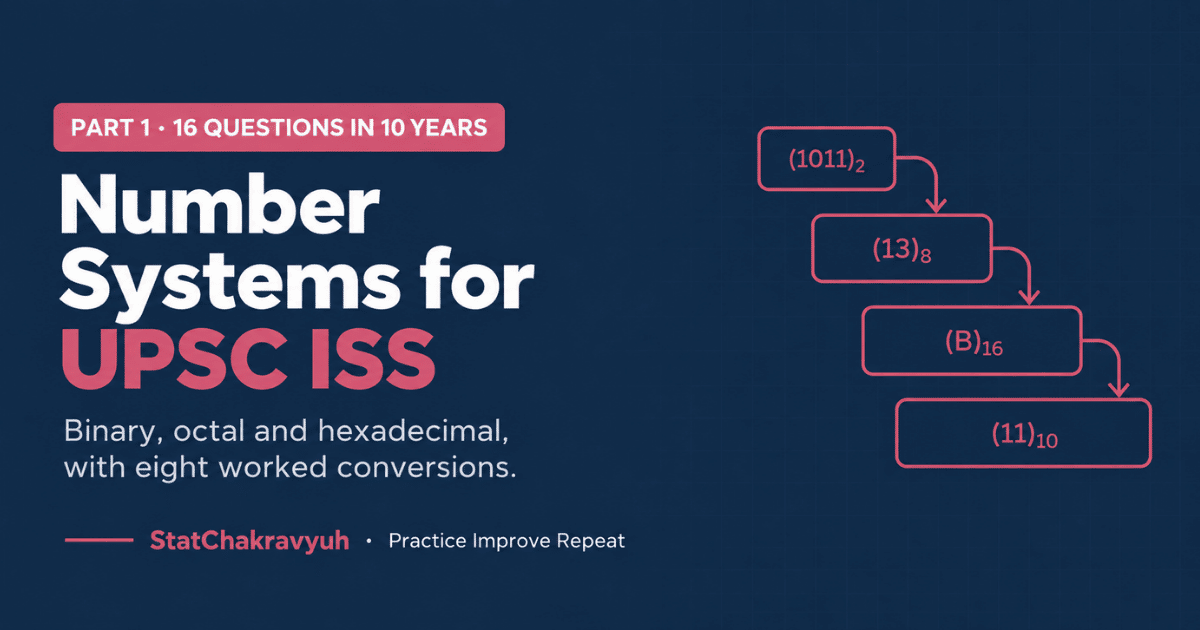
Number Systems for UPSC ISS is the only topic in the Computer section that you can be certain about. Every other part of this section rewards recall. This one rewards method, and a method either works or it does not.
Quick answer. Number systems has appeared 16 times in the last ten papers, an average of about 1.6 questions a year, or roughly 4 marks. Almost all of them are conversions between binary, octal, decimal and hexadecimal. Learn four conversion routes properly and this becomes the most predictable block of marks in Statistics Paper I.
Statistics Paper I, Section IV. Syllabus item: number systems. 16 questions across 2017 to 2026. Add the 10 questions on codes in the next part and this module is worth 26 questions and about 6.5 marks a year.
Why this part comes first
We rated every Computer question in our collection by difficulty. Out of 195 questions, exactly two were rated hard. Both of them are number system questions, and both are in this article.
That sounds discouraging. It is the opposite.
Hard here does not mean conceptually deep. It means long. A hexadecimal to octal conversion with a fractional part has six steps and no shortcut, and a candidate who has never written one out will lose the mark on time, not on understanding. A candidate who has written out three of them will finish it in ninety seconds.
This is the one topic in the Computer section where practice beats reading. Reading a conversion table teaches you nothing. Writing out six conversions teaches you everything.
What a number system actually is
A number system needs two things: a base and a set of digits.
The base tells you how many distinct digits exist. The digits always run from 0 to base minus one. That single rule answers one of the recurring questions outright: the highest digit possible in any number system is one less than its base. There is no 8 in octal and no 2 in binary.
The value of a number is the sum of each digit multiplied by the base raised to its position.
| System | Base | Digits | Written as |
|---|---|---|---|
| Binary | 2 | 0, 1 | (1011)₂ |
| Octal | 8 | 0 to 7 | (325)₈ |
| Decimal | 10 | 0 to 9 | (213)₁₀ |
| Hexadecimal | 16 | 0 to 9, A to F | (2AF)₁₆ |
In hexadecimal, A is 10, B is 11, C is 12, D is 13, E is 14 and F is 15. G does not exist. A question asking which of four strings is not a valid hexadecimal number is asking exactly this, and it is worth 2.5 marks for ten seconds of work.
The five conversions the papers actually ask
There are twelve possible conversion routes between four systems. The papers use five of them.
| Route | Method | Asked |
|---|---|---|
| Any base to decimal | Place value expansion | Often |
| Decimal to any base | Repeated division | Often |
| Binary to octal or hexadecimal | Grouping | Often |
| Octal to hexadecimal | Through binary | Often |
| Hexadecimal to octal | Through binary | Occasionally, and it is the hardest one |
Notice what is missing. Octal to decimal and hexadecimal to decimal are the same method, and decimal to octal and decimal to hexadecimal are the same method. You are not learning five techniques. You are learning three.
Worked Example 1: Any base to decimal
Write each digit against its place value and add.
Convert (2AF)₁₆ to decimal.
| Step | Working |
|---|---|
| 1. Place values, right to left | 16⁰ = 1, 16¹ = 16, 16² = 256 |
| 2. Digits in decimal | 2, A = 10, F = 15 |
| 3. Multiply | 2 × 256 = 512, 10 × 16 = 160, 15 × 1 = 15 |
| 4. Add | 512 + 160 + 15 |
Answer: (2AF)₁₆ = 687
Worked Example 2: A base with a fractional part
The integer part uses positive powers. The fractional part uses negative powers, counting rightward from the point.
Convert (461.24)₈ to decimal.
| Step | Working |
|---|---|
| 1. Integer place values | 8² = 64, 8¹ = 8, 8⁰ = 1 |
| 2. Integer part | 4 × 64 + 6 × 8 + 1 × 1 = 256 + 48 + 1 = 305 |
| 3. Fraction place values | 8⁻¹ = 1/8, 8⁻² = 1/64 |
| 4. Fraction part | 2/8 + 4/64 = 0.25 + 0.0625 = 0.3125 |
| 5. Add | 305 + 0.3125 |
Answer: (461.24)₈ = 305.3125
This is where most marks are lost. The exponent goes negative after the point, and it counts from 1, not from 0. A candidate who writes 8⁰ for the first digit after the point gets a wrong answer that still looks plausible in the options.
Worked Example 3: Decimal to any base
Divide repeatedly by the base. Collect the remainders. Read them bottom to top.
Convert (1000)₁₀ to octal.
| Division | Quotient | Remainder |
|---|---|---|
| 1000 ÷ 8 | 125 | 0 |
| 125 ÷ 8 | 15 | 5 |
| 15 ÷ 8 | 1 | 7 |
| 1 ÷ 8 | 0 | 1 |
Reading the remainder column upward: 1, 7, 5, 0.
Answer: (1000)₁₀ = (1750)₈
Check it: 1 × 512 + 7 × 64 + 5 × 8 + 0 = 512 + 448 + 40 = 1000.
Always check. The check takes fifteen seconds and catches the single most common mistake, which is reading the remainders in the wrong direction.
Worked Example 4: Binary to octal and hexadecimal, by grouping
This is the shortcut that makes the rest easy. Because 8 = 2³ and 16 = 2⁴, each octal digit is exactly three binary digits and each hexadecimal digit is exactly four.
Convert (10110111.1011)₂ to hexadecimal.
| Step | Working |
|---|---|
| 1. Integer part, group in fours from the point leftward | 1011 | 0111 |
| 2. Convert each group | 1011 = B, 0111 = 7 |
| 3. Fraction part, group in fours from the point rightward | 1011 |
| 4. Convert | 1011 = B |
Answer: (10110111.1011)₂ = (B7.B)₁₆
The direction rule. Both sides group outward from the decimal point, never from the ends of the number. If a group falls short, pad it with zeros on the outer side: zeros on the left for the integer part, zeros on the right for the fraction. Getting this backwards is the single biggest source of wrong answers in this topic.
Worked Example 5: Octal to hexadecimal
There is no direct route. Go through binary.
Convert (574)₈ to hexadecimal.
| Step | Working |
|---|---|
| 1. Each octal digit to three bits | 5 = 101, 7 = 111, 4 = 100 |
| 2. String them together | 101111100 |
| 3. Regroup in fours from the right | 1 | 0111 | 1100 |
| 4. Pad the leftmost group | 0001 | 0111 | 1100 |
| 5. Convert each group | 1, 7, C |
Answer: (574)₈ = (17C)₁₆
Check it: (574)₈ = 5 × 64 + 7 × 8 + 4 = 380. (17C)₁₆ = 256 + 112 + 12 = 380.
Worked Example 6: Hexadecimal to octal, with a fraction
This is the longest conversion the papers ask for. Same idea, run in reverse, and the fractional part is where it gets slippery.
Convert (2B5.C)₁₆ to octal.
| Step | Working |
|---|---|
| 1. Each hex digit to four bits | 2 = 0010, B = 1011, 5 = 0101, C = 1100 |
| 2. Write it out | 0010 1011 0101 . 1100 |
| 3. Integer part, regroup in threes from the point leftward | 001 | 010 | 110 | 101 |
| 4. Convert | 1, 2, 6, 5 |
| 5. Fraction, regroup in threes from the point rightward | 110 | 0 |
| 6. Pad the last group on the right | 110 | 000 |
| 7. Convert | 6, 0 |
Answer: (2B5.C)₁₆ = (1265.6)₈
Check it: (2B5)₁₆ = 512 + 176 + 5 = 693, and (1265)₈ = 512 + 128 + 48 + 5 = 693. For the fraction, C is 12/16 = 0.75, and 6 is 6/8 = 0.75.
Step 6 is the whole question. Padding the fractional group on the left instead of the right gives you 0.011 instead of 0.110, and a completely different answer that is usually sitting there as one of the options.
Worked Example 7: Finding an unknown base
Occasionally a question gives you a number in an unknown base and its value in another, and asks for the base.
If (144)ₓ = (100)₁₀, find X.
| Step | Working |
|---|---|
| 1. Expand in base X | 1 × X² + 4 × X + 4 |
| 2. Set equal to 100 | X² + 4X + 4 = 100 |
| 3. Recognise the square | (X + 2)² = 100 |
| 4. Solve | X + 2 = 10, so X = 8 |
Answer: X = 8
Check it: (144)₈ = 64 + 32 + 4 = 100.
One constraint saves you every time. Every digit used must be less than the base. A number written as (144) cannot be in base 4, because 4 is not a valid digit in base 4. Use that to eliminate options before you do any algebra.
Worked Example 8: How much can n bits hold
Two different questions, two different formulas, and they have both been asked.
| Question | Formula | 8 bits gives |
|---|---|---|
| Largest unsigned integer in n bits | 2ⁿ − 1 | 255 |
| Largest signed integer in n bits | 2ⁿ⁻¹ − 1 | 127 |
| Smallest signed integer in n bits | −2ⁿ⁻¹ | −128 |
| Total distinct values in n bits | 2ⁿ | 256 |
Read the options before you choose. If negative numbers appear anywhere in the question or the options, the intended answer is the signed formula. If the question says “can be stored” with no mention of sign, it is the unsigned one.
Fixed point, floating point and normalisation
A fixed point number keeps the decimal point in a fixed, agreed position. Integer arithmetic is fixed point arithmetic with the point at the far right.
A floating point number stores the digits and the position of the point separately, which is why it can hold a much wider range in the same number of bits.
Normalised form puts the number into a standard shape so that every value has exactly one representation.
| Convention | 11.234 becomes | Used by |
|---|---|---|
| Mantissa between 0.1 and 1 | 0.11234 × 10² | Computer fundamentals textbooks |
| Mantissa between 1 and 10 | 1.1234 × 10¹ | Scientific notation and IEEE 754 |
For this paper, the first convention is the one the options are usually built around. Look at the options before committing, because the two are equally correct mathematically and the question is really asking which convention you were taught.
How This Gets Asked
The hardest question in ten years [2022]
In octal number system, the hexadecimal number (32FC.75) is equivalent to
This is Worked Example 6 with bigger numbers. Four hex digits become sixteen bits, regrouped into threes gives you (31374)₈, and the fraction .75 becomes 01110101, which regroups to .352.
Nothing here is difficult. It is simply seven steps under time pressure, which is exactly why it was the only conversion in ten years rated hard.
The other hard one [2023]
Consider the following statements: 1. In number system if (110)ₓ = (1100)₂, then the value of X is 3. 2. The gray coded equivalent of …
(1100)₂ is 12. In base X, (110)ₓ is X² + X. Setting X² + X = 12 gives X = 3, and (110)₃ is indeed 9 + 3 + 0 = 12. Statement 1 is correct.
Notice the shape of the question. Two statements, two different topics, one from conversions and one from Gray code, which is covered in the next part. A paired statement question is two questions wearing one hat, and you need both halves to score.
The most recent one [2026]
Consider the following statements: I. The equivalent octal number of the decimal number 45796 is 131344. II. The equivalent hexadecimal number of the octal number 365 is 0F5.
Both are true. Statement I is repeated division by 8, which gives remainders 4, 4, 3, 1, 3, 1 read upward as 131344. Statement II is octal to binary to hex: 365 becomes 011110101, regrouped as F5.
Two conversions, one question, 2.5 marks. This is the standard modern format and it is why half-knowing the method is not enough.
Quick Revision Table
Everything in this article that has actually been asked.
| Point | Value |
|---|---|
| Highest digit in base r | r − 1 |
| Hexadecimal digits | 0 to 9, then A=10 to F=15 |
| Octal digit in binary | 3 bits |
| Hexadecimal digit in binary | 4 bits |
| Grouping direction | Outward from the point, both sides |
| Padding | Left for the integer part, right for the fraction |
| Any base to decimal | Place value expansion |
| Decimal to any base | Repeated division, read remainders upward |
| Octal to hex and hex to octal | Always through binary |
| Fraction place values | Negative powers, starting at −1 |
| Largest unsigned in n bits | 2ⁿ − 1 |
| Largest signed in n bits | 2ⁿ⁻¹ − 1 |
| Distinct values in n bits | 2ⁿ |
| Normalised form, textbook convention | Mantissa between 0.1 and 1 |
Practice Set
Ten questions. No answer key below.
Write your answers in the comments, all ten in a single comment, in the format 1-b 2-a 3-d and so on. The full answer key is posted in this same thread after seven days.
A year in brackets means the question is from that paper.
- What is the decimal equivalent of the hexadecimal number FFFE? [2017]
- Conversion of the octal number 325.12 into its decimal number will be [2018]
- The maximum decimal integer number that can be stored in the memory of an 8 bit word processor computer is [2018]
- The maximum permissible integer in a computer with an n-bit word processor and one word per integer is equal to [2018]
- When (217)₁₀ is divided by (12)₁₀, then the quotient and remainder in the binary system will be respectively [2019]
- In the hexadecimal system, the binary number (111110111.110101)₂ is equivalent to [2020]
- Which one of the following is not a valid hexadecimal number? [2020]
- The hexadecimal equivalent of (6251)₈ is [2021]
- The highest digit possible in any number system is [2022]
- Consider the following statements: I. The hexadecimal equivalent of the octal number 366 is 0F6. II. The decimal equivalent of the hexadecimal number A53 is 2643. Which of the statements given above is or are correct? [2025]
Attempt all ten before you look anything up. Getting four wrong tells you exactly which conversion route you have not written out enough times. That is information a third reading of this article will never give you.
Frequently Asked Questions
How many questions come from number systems in UPSC ISS?
Sixteen questions across the ten papers from 2017 to 2026, an average of 1.6 a year, worth about 4 marks. Adding the codes and binary arithmetic questions takes the module to 26 questions.
Is Number Systems for UPSC ISS a difficult topic?
No, but it is the slowest. Of 195 Computer questions we rated, only two were hard, and both were long conversions rather than difficult concepts. Written practice removes the difficulty entirely.
Which conversions should I practise most?
Binary to hexadecimal, octal to hexadecimal, and decimal to any base. Hexadecimal to octal with a fractional part is the longest and appears less often, but it is the one that costs candidates the most time when it does.
How do I convert a fractional part correctly?
Group outward from the point in both directions, never from the ends of the number. Pad short groups with zeros on the outer side, which means on the left for the integer part and on the right for the fraction.
What is the largest number an 8 bit computer can store?
255 if the number is unsigned, using 2ⁿ − 1. 127 if it is signed, using 2ⁿ⁻¹ − 1. Both formulas have been asked, so read the options before choosing.
Do I need to memorise the binary values of hexadecimal digits?
Only 0 to 15 in four bits, which is sixteen patterns and takes an afternoon. Once those are automatic, every grouping conversion becomes mechanical.
Is a calculator allowed in UPSC ISS Statistics Paper I?
No. Statistics Paper I is an objective paper without a calculator, which is precisely why the conversion methods need to be written out by hand until they are quick.
Related Reading
- Computer Application for UPSC ISS: Complete 16 Part Series
- Codes and Binary Arithmetic for UPSC ISS
- UPSC ISS Syllabus, Paper by Paper
- UPSC ISS Previous Year Papers
Part 1 of 16 in the Computer Series for UPSC ISS. Next: Codes and Binary Arithmetic for UPSC ISS, published 3 October at 8:00 AM.