
India Bangladesh relations 2026 is the most predictable question on this list, and that is not a criticism. It is the reason to prepare it.
Look at any UPSC ISS General Studies paper from the last decade and notice something at the very end of Question 4. The final part is almost always International Relations, and more often than not it concerns a neighbour. One 5 mark part, about nine minutes of your time, and the single most predictable location in the entire paper.
Short answer. A trust deficit is the gap between what two countries expect from each other and what they actually observe. More than a hundred days into the new government in Dhaka, India and Bangladesh relations remain strained. The pending issues include renewal of the Ganga Water Treaty of 1996 by 31 December 2026, unresolved visa and trade restrictions, political rhetoric around illegal immigration, growing Bangladeshi engagement with China, and domestic instability in Bangladesh.
What a Trust Deficit Is
A trust deficit is the gap between the expectations two countries hold of one another and the conduct they actually see. When outcomes repeatedly fall short of expectations, doubts arise about intentions and commitments, and cooperation shrinks.
The visible symptoms are consistent across cases: diplomatic engagement slows, agreements and negotiations are delayed, security and intelligence cooperation is reduced, nationalist rhetoric rises on both sides, and strategic partnerships weaken.
Defining the term properly in your opening line is worth doing, because it turns a news summary into an analytical answer.
The Foundation, Which Explains the Strain
You cannot explain the present strain without the past closeness.
Bangladesh was formerly East Pakistan, where political discrimination, economic neglect and cultural suppression by West Pakistan produced widespread resentment. In March 1971 Pakistan launched Operation Searchlight to suppress the Bengali nationalist movement, resulting in large scale atrocities, mass displacement and a severe humanitarian crisis.
India’s role was decisive on three fronts:
- It sheltered nearly ten million refugees
- It trained and supported the Mukti Bahini
- It intervened militarily in December 1971
Bangladesh emerged as an independent nation on 16 December 1971, and India came to be seen as its liberator, which created expectations of long term friendship and strategic cooperation.
The civilisational layer
Alongside that history run deep cultural ties. Bengali, spoken by more than 230 million people, is a natural bridge. Rabindranath Tagore, Kazi Nazrul Islam and Sarat Chandra Chattopadhyay are shared icons. Durga Puja, Pohela Boishakh, Baul music and the Bengal Renaissance heritage are shared traditions.
Thousands of Bangladeshis travel to India each year for medical treatment, higher education and business, with Chennai, Delhi and Kolkata as major destinations.
What Strains India Bangladesh Relations 2026
| Issue | Why it strains the relationship |
|---|---|
| Ganga Water Treaty, 1996 | Due for renewal by 31 December 2026. Water sharing, including the pending Teesta question, is emotionally and economically sensitive on both sides. |
| Visa and trade restrictions | Curbs introduced during political turmoil have not been fully rolled back, affecting travel, medical access and commerce. |
| Migration rhetoric | Political language on illegal immigration in India, and anti India narratives in parts of Bangladeshi politics, feed mutual suspicion. |
| The China factor | Deepening Bangladeshi engagement with China in infrastructure and defence raises strategic concerns in New Delhi. |
| Domestic instability | Political transition and concerns about minorities in Bangladesh complicate steady engagement. |
| Legacy of past alignment | India’s earlier closeness to the previous government makes the new leadership cautious. |
India’s Outreach, and the Principle Behind It
India’s diplomatic response has been steady rather than dramatic.
Before the new Prime Minister formally assumed office, the External Affairs Minister visited Dhaka on 31 December 2025. India also sent the Foreign Secretary and the Speaker of the Lok Sabha to the swearing in ceremony.
The objective in both cases was the same: demonstrate goodwill and establish constructive relations with an incoming administration regardless of its political colour.
That is a useful point for an answer, because it illustrates a principle.
Mature diplomacy engages the office, not the individual. States deal with governments as they find them.
The Way Forward
Five points, and naming instruments rather than intentions is what earns the marks.
Settle water first. Early and transparent renewal of the Ganga Water Treaty, along with movement on the Teesta question, would remove the single largest source of distrust and demonstrate reliability.
Restore economic normalcy. Rolling back visa and trade restrictions helps both economies. Connectivity through border haats, rail links, power trade and inland waterways builds interdependence that survives political change.
Protect the people to people layer. Medical travel, education, cultural exchange and shared Bengali heritage are India’s most durable assets in Bangladesh, and they operate below the level of politics.
Manage rhetoric. Domestic political language in either country carries across the border instantly. Restraint is a foreign policy instrument, not merely good manners.
Recall what has worked. The Land Boundary Agreement of 2015 settled a complicated enclave problem that had lasted decades. It is proof that difficult bilateral issues can be resolved when both sides commit.
The Strategic Logic in Two Numbers
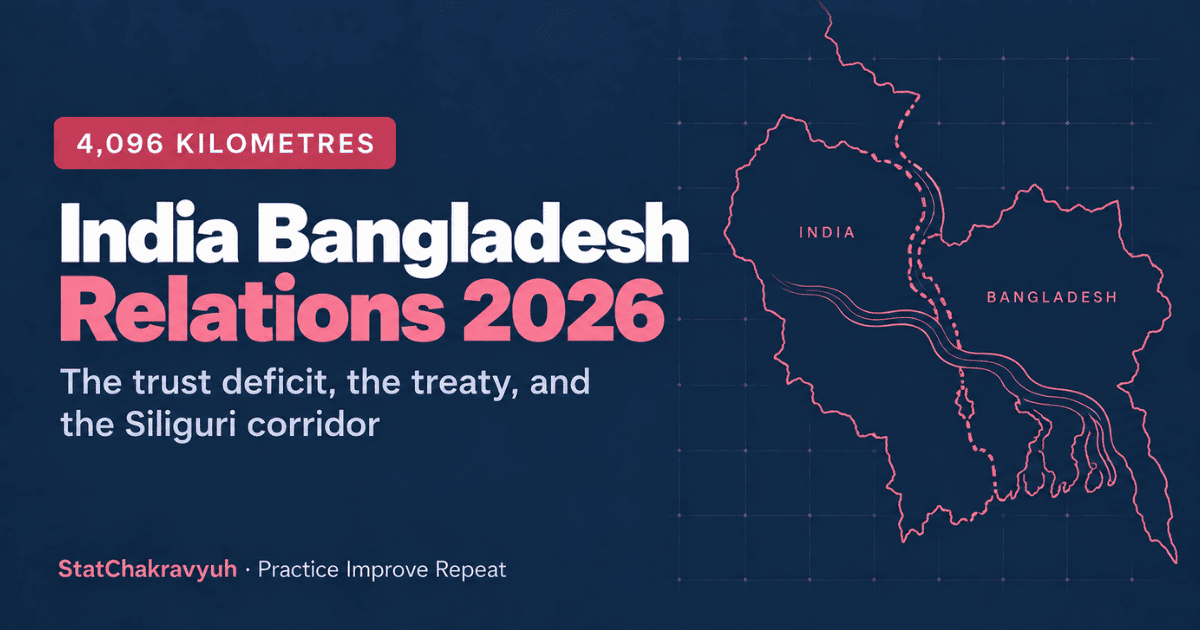
India shares a land border of about 4,096 kilometres with Bangladesh, its longest with any country, and that border runs alongside the narrow Siliguri corridor connecting the northeast.
A cooperative eastern neighbour is not a preference for India. It is a requirement.
That is the closing line of this answer, and it is why a bilateral irritant becomes a strategic problem.
How This Is Asked in the UPSC ISS Paper
International Relations is almost always exactly one part at the end of Question 4.
Past papers have covered the South Asian Association for Regional Cooperation, which appeared three times, along with BRICS, reform of the United Nations Security Council, India and Pakistan relations, neighbourhood shifts and multi alignment.
A likely framing: the India and Bangladesh relationship is passing through a phase of trust deficit. Examine the major irritants and suggest a way forward.
Verify the pattern in the previous year papers
Model answer skeleton, about 200 words
- Opening. Define the trust deficit and note that ties remain strained despite the historical foundation of 1971.
- Foundation. India’s role in the Liberation War, Bangladesh’s emergence on 16 December 1971, and the shared cultural inheritance.
- Irritants. Ganga Water Treaty renewal by 31 December 2026, visa and trade curbs, migration rhetoric, the China factor and domestic instability.
- India’s outreach. The ministerial visit to Dhaka and high level representation at the swearing in.
- Way forward. Water agreements, restored trade and connectivity, people to people ties and restrained political language.
- Closing. With a border of about 4,096 kilometres and the Siliguri corridor at stake, restoring trust is a strategic necessity rather than a diplomatic courtesy.
Three Mistakes to Avoid
Writing only about 1971. The history explains the expectation. It does not explain the present, and an answer that stops in 1971 has answered a different question.
Listing irritants without a way forward. The question almost always asks for both. Half your words belong to the second half.
Writing “improve relations” without naming instruments. Border haats, rail links, power trade, inland waterways, treaty renewal. Specific instruments beat general goodwill in every answer you will ever write.
Frequently Asked Questions
What is the trust deficit in India Bangladesh relations?
The gap between the expectations the two countries hold of each other and the conduct they actually observe. Its symptoms include slowed diplomatic engagement, delayed agreements, reduced security cooperation and rising nationalist rhetoric.
When does the Ganga Water Treaty need renewal?
By 31 December 2026. It was signed in 1996, and water sharing, including the pending Teesta question, is economically and emotionally sensitive on both sides.
What are the main irritants in India Bangladesh relations 2026?
Renewal of the Ganga Water Treaty, unresolved visa and trade restrictions, political rhetoric on illegal immigration, deepening Bangladeshi engagement with China, domestic instability, and India’s earlier closeness to the previous government.
How long is the India Bangladesh border?
About 4,096 kilometres, India’s longest land border with any country. It runs alongside the narrow Siliguri corridor connecting the northeast.
What was the Land Boundary Agreement of 2015?
An agreement that settled a complicated enclave problem between India and Bangladesh that had lasted decades. It is cited as proof that difficult bilateral issues can be resolved when both sides commit.
What is the Siliguri corridor?
The narrow strip of Indian territory connecting the northeastern states to the rest of the country. Its proximity to the Bangladesh border is what makes a cooperative eastern neighbour a strategic requirement for India.
How often is International Relations asked in the ISS paper?
It is almost always exactly one part at the end of Question 4. Past papers have covered SAARC three times, along with BRICS, UN Security Council reform, India Pakistan relations and multi alignment.
What Comes Next
Two articles remain, both History. The next covers a site that moved from being a fact you memorise to a fact you can argue with.
Next: Sarnath UNESCO World Heritage Site, explained for UPSC ISS
Practice. Improve. Repeat.
Sources
Ministry of External Affairs (mea.gov.in), Press Information Bureau (pib.gov.in), Ministry of Jal Shakti.