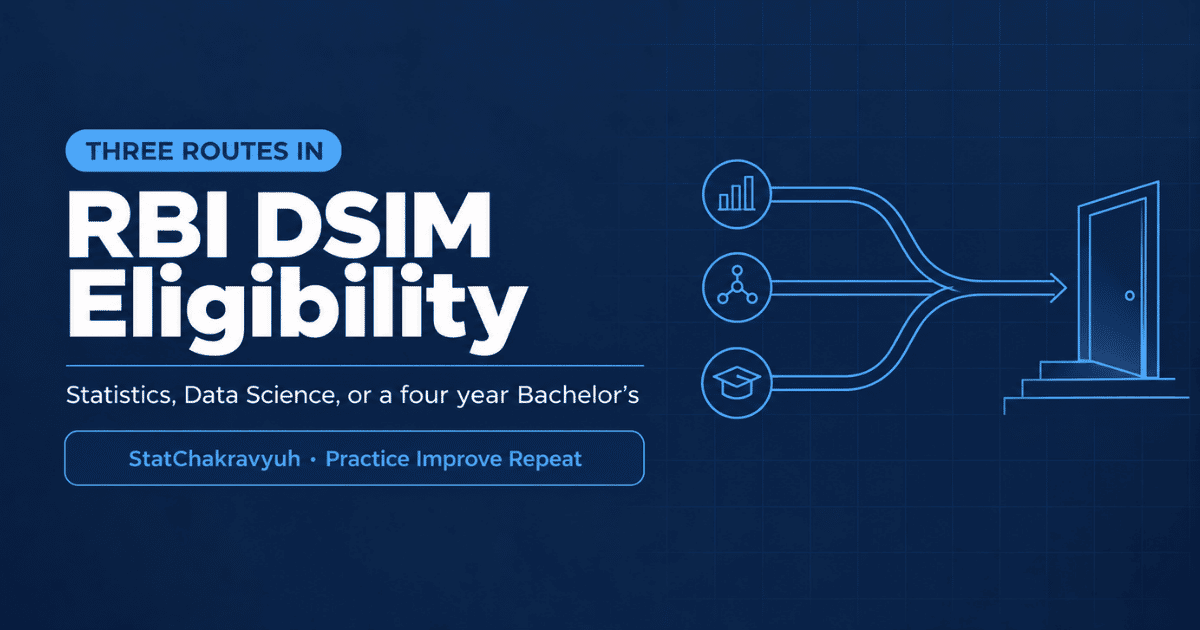
Quick answer. RBI Grade B DSIM has three eligibility routes: a Master’s with 55 percent in Statistics or a related quantitative subject, a Master’s with 55 percent in Data Science, AI, Machine Learning or Big Data Analytics, or a four year Bachelor’s with 60 percent in any of those. SC, ST and PwBD candidates need 50 percent. Age is 21 to 30 years on the cutoff date, with 5 years relaxation for SC and ST and 3 years for OBC. General and EWS candidates who have already appeared six times for Phase I cannot apply again.
The Three Routes
You need any one of these.
Route A: the classical route
Master’s degree with a minimum 55 percent in aggregate across all semesters or years, or an equivalent CGPA, in:
Statistics, Mathematics, Mathematical Statistics, Applied Statistics, Quantitative Economics, Econometrics, Informatics, or any other related branch of these areas.
Route B: the data science route
Master’s degree with a minimum 55 percent in:
Data Science, Artificial Intelligence, Machine Learning, Big Data Analytics, or any other related branch.
Route C: the four year Bachelor’s route
Four year Bachelor’s degree with a minimum 60 percent in any of the subjects named in Routes A or B.
Note the higher bar. A four year Bachelor’s needs 60 percent where a Master’s needs 55.
The relaxation
For SC, ST and PwBD candidates, the minimum in all three routes drops to 50 percent, where posts are reserved for them.
Two Things People Miss
Route B exists. A Master’s in Data Science or Machine Learning qualifies you for a Reserve Bank Statistics cadre post. Plenty of people with exactly that degree never look at DSIM because the cadre name says Statistics.
Route C exists. A four year Bachelor’s degree, with 60 percent, is enough. You do not need a Master’s at all. Candidates finishing four year integrated or honours programmes routinely assume they must wait, and they do not.
What Counts as Desirable
These are not requirements, but the Board states them explicitly.
- A doctorate in a related topic is given preference
- Research or teaching experience and publications in standard journals count as an additional qualification
M.Phil and PhD holders also receive age relaxation as specified in the notification.
Age Limit
| Item | Detail |
|---|---|
| Minimum | 21 years on the cutoff date |
| Maximum | 30 years on the cutoff date |
| 2026 cutoff | 1 April 2026 |
| SC and ST | Up to 5 years relaxation |
| OBC | Up to 3 years relaxation |
For the 2026 cycle, that meant candidates born between 2 April 1996 and 1 April 2005.
The cutoff date moves each cycle. Check it against the current advertisement rather than assuming it is 1 April.
Number of Attempts
General and EWS candidates who have already appeared six times for the Phase I examination for this post cannot apply again.
There is no such restriction for SC, ST, OBC and PwBD candidates, where posts are reserved for them.
Note the wording carefully. It counts appearances at Phase I, not applications. Applying and not appearing does not consume an attempt.
Application Fee
| Category | Charges |
|---|---|
| SC, ST and PwBD | Rs 100 plus 18 percent GST, intimation charges only |
| General, OBC and EWS | Rs 850 plus 18 percent GST |
| RBI staff candidates | Nil |
Bank and transaction charges are borne by you. The fee is not refundable under any circumstances and cannot be carried to another examination.
Three Rules That Catch People Out
One: eligibility is checked only at the interview
This is unusual and it matters.
The Board admits everyone who applies with the correct fee, based purely on what you declared in the online application. Eligibility is determined only at the final stage, the interview.
If it turns out then that your information was incorrect or that you do not meet the criteria, your candidature is cancelled, you are not interviewed, and you claim no travelling reimbursement. If you have already joined the Bank, you can be removed without notice.
An admit card does not mean you qualify. Check your own eligibility properly before applying.
Two: the edit window covers only five fields
After the application closes, a two day edit window opens. Only these five fields can be changed:
- Examination centre
- Medium of examination
- Father’s name
- Mother’s name
- Class 10 or 12 percentage
Nothing else. Not your category, not your date of birth, not your qualification details. After the edit window closes, no change is permitted under any circumstances.
Three: category cannot be changed later
If you indicate General in the application and later write asking to change to a reserved category, or the reverse, the request will not be entertained. The same applies to EWS and PwBD.
One More Thing Worth Knowing
Pre examination training is not available for DSIM.
The Bank arranges free online pre examination training for SC, ST, OBC and PwBD candidates, but only for the General cadre. DEPR and DSIM candidates are not covered.
Frequently Asked Questions
What is the eligibility for RBI Grade B DSIM?
Any one of three routes: a Master’s with 55 percent in Statistics, Mathematics, Mathematical Statistics, Applied Statistics, Quantitative Economics, Econometrics or Informatics; a Master’s with 55 percent in Data Science, Artificial Intelligence, Machine Learning or Big Data Analytics; or a four year Bachelor’s with 60 percent in any of these.
Can I apply for RBI DSIM with a Data Science degree?
Yes. A Master’s degree with 55 percent in Data Science, Artificial Intelligence, Machine Learning or Big Data Analytics is an explicit eligibility route.
Can I apply with only a Bachelor’s degree?
Yes, if it is a four year Bachelor’s degree with at least 60 percent in a qualifying subject.
What is the age limit for RBI DSIM?
21 to 30 years on the cutoff date, with up to 5 years relaxation for SC and ST and up to 3 years for OBC.
How many attempts are allowed for RBI DSIM?
General and EWS candidates who have already appeared six times for Phase I cannot apply again. There is no restriction for SC, ST, OBC and PwBD candidates where posts are reserved.
What is the application fee for RBI DSIM?
Rs 850 plus 18 percent GST for General, OBC and EWS. Rs 100 plus 18 percent GST for SC, ST and PwBD as intimation charges only.
Can I change my category after applying?
No. Requests to change category after submission are not entertained, for any category.
When is eligibility verified?
Only at the interview stage. Being issued an admit card does not confirm that your candidature has been cleared.